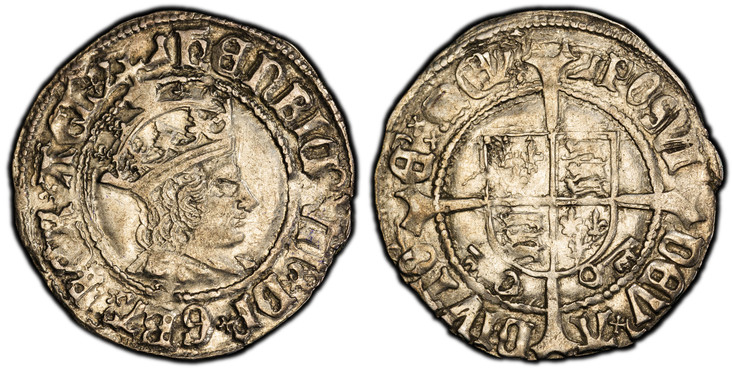
1086654 | GREAT BRITAIN. England. Henry VII. (King, 1485-1509).
(1504-09)-(Martlet) (Archbishop Bainbridge) AR 1/2 Groat (Twopence). PCGS AU50. York Mint. 1.69gm. Crowned bust, right
/ Coat-of-arms over long cross fourchee. SCBC-2262; North 1751/1; LH 156; P & W 2; cf. SCBI Ashmolean 931ff.
Ex. Littlebrook Hoard of Tudor Silver Coins (Noonan's London 10 February 2026).
Please use this link to verify the PCGS certification number
61874210
From Noonan's Introduction on the Littlebrook Hoard:
The Littlebrook Hoard was discovered on 12 May 2004 during excavations for the foundations of a new extension to Littlebrook Farm in Belchalwell Street, Dorset. The farmhouse is a grade 2 listed dwelling and is said to date from the early seventeenth century although evidence has shown that a dwelling or buildings certainly pre-dated that period. The current owners gained permission to extend the building, with early photographs in their possession confirming that the new build would, in fact, replace a previously destroyed structure. The removal of a concrete area, then used for car parking, revealed a terracotta tiled floor, these tiles being carefully removed for use elsewhere. When work on the new foundations began, the mechanical digger unearthed a pottery jug which was found to contain 213 silver coins, 176 groats and 37 half groats in varying condition, the bulk dating from the reign of Henry VII (1485-1509). As required, the find was reported and submitted to the British Museum and the coins were examined and catalogued by Dr Barrie Cook, the Curator of Medieval Coins. An inquest was held in Dorchester in March 2005 and the find was confirmed as Treasure Trove and thus subject to the relevant legal rules.
The coins are all English silver issues and of the official sterling silver standard. The fact that the coins were discovered in a container is clear evidence that they were deposited on a single occasion and they represent a selected body of higher value silver coins from the currency of the early sixteenth century, before the new weight standard of 1526 was introduced. The earliest coin recorded was a half groat from the reign of Edward III, dated c. 1351-2, and the latest a half groat issued from York after Wolsey was appointed bishop in 1514. The coins are thought to have been deposited probably c. 1514-1520. The reasons for their deposit are not known. Littlebrook Farm lies in an isolated area of the Blackmore Vale, a mile from the nearest hamlet and about 14 miles from Dorchester. The area is known to be on the regular smuggling routes from the coastal areas of Portland to centres such as Salisbury and Bristol which could be an explanation for the hoard’s deposit.
The pottery jug, which unfortunately was broken during the lifting, is of simple design with a crimped edge and was confirmed by the Museum as dating from the late fifteenth century and originating from the Ruhr area of Germany. In accordance with the rules relating to Treasure the hoard was offered to local museums and the jug and thirteen of the coins were removed and are now the property of the Dorset County Museum. After discussion and settlement with the finders, the current owners decided to retain the remaining 200 coins but have now decided to offer them for sale on the open market with full provenance.
Most British medieval coin hoards tend to contain only the larger denominations in circulation, the smaller coins being deliberately excluded by the saver. These are referred to as ‘savings hoards’. On the other hand, deposits of the contents of a purse or pocket will contain the small denomination coins which circulated on a daily basis - these are often called ‘circulation hoards’ or ‘purse finds’.
Numismatically, the present savings hoard represents a typical selection of coinage of the period and seems to be an amalgam of two distinct groups - the figures given below are based on the 200 coins offered for sale in this catalogue (the 13 coins retained by the Dorset Museum do not materially affect the overview of the contents or the conclusions drawn). The earlier group comprises 12 coins struck between 1465 and 1478 [lots 197-208]. These pieces, whilst not being in as good condition as the later coins, do not exhibit sufficient wear to have been in continuous circulation for the best part of fifty years and appear to have been set aside some years before the final deposit. The balance of 188 pieces dates from c. 1498-1515 [lots 209-396]. There are only two coins (both retained by the Dorset Museum) coins which were issued during the intervening 20 years or so. While it is not surprising that the rare issues of Richard III are not present, the dearth of the earlier types of Henry VII (Potter & Winstanley I, II, IIIa and IIIb) is a little puzzling and probably points to the deposit being from two discrete sources.
The chronology and dating of the issues of Henry VII have still not been fully agreed among numismatists but the present hoard fits within the parameters of what is currently accepted. The bulk of the coins in the hoard were struck during the course of the cross-crosslet and pheon mintmarks. The former, introduced in the spring of 1504, marks the transition from facing to profile bust type - a complex sequence of issues, some experimental, including facing bust, tentative and regular profile coins spanning a busy 18 month period during 1504-05. As the new design became established, the mark was changed to pheon and coins of this type were issued until the end of the reign (and a few months into the following); surviving records show large quantities of silver were processed during this period. In the new reign, the ratio of coins of different mintmarks and their overall relatively unworn condition suggests the hoard was deposited no later than c. 1520.
Among the Henry VII highlights in the hoard are a rare and attractive crowned leopard’s head facing bust groat [lot 212], three tentative issue groats [lots 237-9], two rare regular profile groats with double mintmark on reverse [lots 261-2], and an apparently unrecorded martlet/rose halfgroat of Abp. Bainbridge of York [lot 365]. In the following reign, there are four rare groats with mm. pheon, one with the Kings’s numeral altered from VII to VIII [lots 366-9], a groat with mm. portcullis over crowned T, reusing an obverse die originally cut for the coinage of Tournai in the late spring of 1514 [lot 396] and a mm. castle Groat with the highly unusual reading AGLIE [lot 373].